Living in Interesting Times

Reality is subjective. I never used to think that. I mean, how can reality, something that one would assume can be empirically proved or disproved, be open to interpretation, conditioned on whether someone accepts it or doesn’t accept it?

Then came social media, which does have some uses (hi fam) but is also a veritable, all you can eat buffet of political polarization, culture clashes, countless conspiracy theories, and trolls of every persuasion. So many opinions, so little tolerance. I sometimes say opinions are like farts: everyone has them, no one wants to hear anyone else’s and most of them stink. Except mine of course. Mine smell like roses.

But back to reality, so to speak. Let’s look at something that one would think is a fact or isn’t: COVID-19. Maybe you’ve heard of it. It is a particularly nasty virus circulating around the globe with a high infection rate, a higher than average death rate, and long-term consequences for those who contract  and survive it. Or is it? I guess that depends on who you listen to, or what you believe yourself. For health care workers, for example, it seems to be undeniable and has brought about a relentless ordeal that is overtaxing every health-care system that has to deal with it. But that’s not unilaterally true either, as a number of Youtube videos are circulating, produced by health care workers claiming that we’re being scammed and that there are empty hospital beds and unused ventilators stockpiled in basements. Some people believe COVID-19 is such a threat that they put on masks and gloves to bring their bins to the sidewalk. Others are having COVID-19 parties because it’s all a load of nonsense, until they actually contract the virus and change their belief, or not. Economies are shut down and people are put out of work because we’re being indoctrinated into the New World Order with Bill Gates set to vaccinate us with the mark of the beast, or else it’s because we’re facing a potentially catastrophic pandemic about which next to nothing was known initially and, even with discoveries made daily, there are still too many knowledge gaps for comfort. And it was all manufactured in China, or came from eating bats, or something else.

If you are waiting for me to tell you who is right you will be disappointed. Everybody is right, or at least everybody believes they are right. Each of these concepts represents somebody’s truth, their reality. How can this be? Wouldn’t it be a simple thing to prove, at the very least, what the basic facts are about COVID-19 in a way that cannot be disputed? No. But we can’t trust the main-stream media. They each have their own agendas and slants on events in line with their corporate owners. We can’t trust scientists. Who’s funding them and what are their vested interests? We really can’t trust politicians. At best, they are trying to juggle economic considerations and the health and safety of the population, with varying degrees (or lack) of success. In Ireland, for example, we’re telling everyone to wear a mask and be vigilant, but then we’re letting tourists fly in from highly-infected Texas who are apparently meant to quarantine on the honour system (i.e. not quarantine). When we can’t count on anyone to be straight with us, the best we can do is attempt to triangulate what the facts are by looking to see where the various accounts intersect.

“May you live in interesting times” is, ironically, a Chinese curse. The times are certainly interesting, and uncertain. We are challenged with conflicting scenarios and are left to choose what we believe to be true based on how we filter what we see, hear and intuit for ourselves. Our worlds are changing drastically, with this virus being only one example of a catalyst bringing about that change. We can be stressed and even fearful of those changes, as many are, or we can try to take this malleable world, focussing on shifting it in a direction of our choosing that is aligned with love and compassion, while trying not to get distracted by the potential triggers bombarding us daily.

Tarot Insights: Knight of Cups

20170803_083528[1]
Knight of Cups – Bonefire Deck

I think of knights as fire, full of the passionate energy of youth. Not wide-eyed innocent pages, but high-spirited teenagers, sometimes rebellious, sometimes stroppy, usually full of themselves—knowing they are right about everything, constantly testing their boundaries. When we apply this to the Knight of Cups, we see someone who is passionate about following their heart, who puts more emphasis on their emotions than their logic, and who has a faith in their intuition.

In the Bonefire deck, the Knight of Wands seems to be surrounded by a lavender cloud that takes up most of the illustration. This also seems to be the color of what little of his horse we can see. The feeling I get is that this knight is surrounded by his dreams, perhaps emphasized by the few bubbles we can also see. He gazes at a chalice filled with rose wine. Yet his head is above the clouds, the sun is shining big and bright and the wine is captured by the sun’s corona.

This might seem like a contradiction, but it’s more an indication that the knight is aware of the “real” world even though he seems to be overindulging in his dream world. With knights, their energy can veer from one extreme to another. The trick is  finding the balance. I think this illustration convey’s this point well.

Whether it’s healing, divining, manifesting or something else, a lot of energy work requires the open-heartedness and intuition of the cups. The knight is enthusiastic about immersing himself in those energies, and it can be a real buzz to do so. While healing takes place for ourselves and others in this space, it is often a very personal experience. There is also a three-dimensional world out there, the one most people perceive as reality, the one in which most people interact with us. It’s important to try to maintain a balance so that we don’t get so caught up in dreams that we diminish our connection to others.

Tarot Insights: The Magician

All that Potential…

The Magician, Bonefire Tarot Deck
The Magician—Bonefire Tarot Deck

In contrast to the rather static depiction of the Magician in the RWS deck, showing all potential but no real action, the Bonefire Tarot Magician is surrounded by representatives of the elements that swirl around him. Nothing is manifest yet, but something is about to come into being—the creative process is in motion. You can nearly hear the crack of electricity as light begins to emerge from the Magician’s wand.

As close as this magician is to the moment of creation, it is still the energy of potential and not actualization. Kind of like the fool walking up to the edge then not quite stepping off the precipice. We’re still not there yet.

I’m struck now by how often I hear about dreams, plans, ideas, or even have them myself, that for one reason or another are never acted upon. I’m not saying they’re all good ideas, but at least some of them could be, and in many cases how can you tell until you begin to try to realize them? All the things we could create, the ways in which we could change the world, the people we could heal. All that potential, all that power to create.

But if it remains potential, what is it worth? Is it just a story we tell ourselves? How good life could be if only this or that would happen? Are we afraid to act? Do we not have enough faith in ourselves to bring the dream to reality? Not enough time? Don’t know how to get from point A to point Z? Are we too concerned about what others might say? What stops you from letting your inner Magician follow through to manifestation.

Hopefully your Magician isn’t completely frustrated or resigned to perceived “reality”. We sometimes find we can create in some areas while having problems in others. Yet those difficult areas are often the challenges we are meant to tackle in this life. And we can—that potential, everything we need is there inside of us, ready to be realized. What are you going to do with it

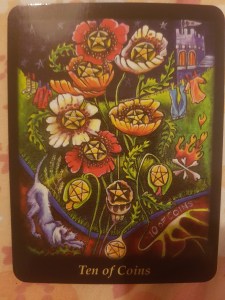
Tarot Insights: Ten of Coins

Ten of Coins—Bonefire Tarot Deck
Ten of Coins—Bonefire Tarot

In the Bonefire deck, the Ten of Coins (aka pentacles) is illustrated by ten flowers in bloom, a coin in the center of each, growing in lush green grass. We can see the roots of one of the flowers, and there is a dog sniffing around the foreground, seemingly also at root level.  A castle sits in the background. Between the flowers and the castle is a clothesline with a few items of clothing that seem plain yet new, or at least well cared for.

The ten of Coins is the culmination of that practical, tangible, material earth energy. It is often associated with family, especially in association with legacies or Dynasties. Every family has its own traditions and attributes that make them unique, and in the best of circumstances they are handed down and cherished from generation to generation as a linear connection to shared ancestry, stretching back to the beginning of civilization, uniting more of us the further back we follow the line, forming a strong connection to our foundation. The castle in the background is a stand-in for that foundation—for how many generations has that castle served as a dwelling, and for how many more will it remain.

The family legacy might take the form of a family business, or it might be a talent that runs in the family, musicianship, for example. Whatever ties this family together there is strength, security, and abundance. This family is secure and thriving. All is well.

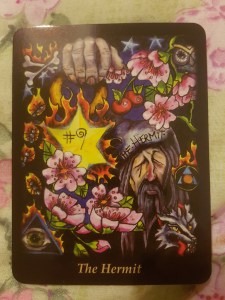
Tarot Insights: The Hermit

The Hermit, Bonefire Tarot Deck
The Hermit—Bonefire Tarot

There is conflicting energy in The Hermit as he is pulled in two different directions. He shines the light of a star from out his lantern, but he is using that light to look within.  And with that inner focus he is also called on to share his knowledge and wisdom with the outer world

We think of the Hermit as someone who is off on their own, but reality is usually not so literal. Most of us don’t have the opportunity to live in a cave. We have to exist in the mundane world with everyone else and deal with the distractions that come from it. In that environment, The Hermit is the one who can unplug himself from social media, get off the treadmill of the daily routine, turn off the autopilot reaction to emotional stimuli. This doesn’t need to be all day every day, but often enough and long enough to develop a personal relationship with the inner world.

In those moments of solitude, The Hermit shines the starlight lantern inward in order to see himself clearly. The Hermit looks fearlessly and objectively at the inner shadows as well as the bright spots. Not judging but observing, discovering the holistic self and accepting that self for who he is, integrating the light and the shadow to be at peace with himself. In so doing, the Hermit discovers the universe as it is contained within.

With all that self-seeking, the Hermit has a calling to share what they discover with others, not necessarily the personal, but as a spiritual teacher. Because the inner-seeking and teaching are ongoing processes, the Hermit’s methods and message will change over time as he learns more. Knowledge will increase, belief’s will change and some will be abandoned. That’s why they call it “Seeking” and not “Found it”.

The Hermit does not need to be a guru selling out workshops to teach. Displaying business ethics regardless of gain, setting an example for your friends, having an openhearted conversation over coffee, parenting , blogging—there are always opportunities to teach. The Hermit knows that we are all connected, and that shining a light makes the path brighter for everyone.

Tarot Insights: Five of Swords

swords5_bonefireI’ve been working with the Bonefire deck recently, where previously I worked mainly with the RWS deck. In the latter, the Five of Swords seems a bit ambiguous—is that person in the foreground collecting the swords for the others, or is he stealing them while their backs are turned? The Bonefire Five of Swords seems a little more straight forward— two tattooed, brawny men duking it out over a woman, pursuing their own self-interest.  The one tattooed with the name and number of the card just landed a solid blow on the jaw of the Tao-tattooed guy, meanwhile the woman in the background gazes at the sunset with her back to them. Probably just as well, or she might decide to write-off both these guys. Maybe she already has, and maybe they’re fighting over which one of them to blame.
Maybe the bearded one felt entitled to ingratiate himself into an existing relationship, and and what we are seeing is the release of the Five of Swords guy after putting up with so much for so long. Let’s stick with that vibe for a moment, because I feel like that’s what this card might be saying this morning. This is what happens when you let people walk all over you for too long while you rationalize, make excuses, and put others ahead of yourself. You know that it happens all the time in a variety of different contexts. Then one day, WHAM! All that pent up frustration finds an outlet.

It’s OK to be selfish. If you can’t take care of yourself, how can you take care of anyone else? You’re not a martyr—That would be the Ten of Swords. But being selfish doesn’t need to be taken to the literal extremes seen here. There is a great amount of scope for balance between being a doormat and flattening someone into a doormat.

Sometimes we can get to a Five of Swords point because we are not communicating our truth effectively. We gloss over what we think, believe, want and/or need. Why? Fear of rejection? Not wanting to rock the boat? Assuming what the response will be and not wanting to have to deal with it?

You can only be who you are. You can try to be who you’re not, but the ruse will fall apart at some point and no one will be happy, especially you. There will be times that this will rock the boat, and at those times you might need to ask yourself if you are a minor actor in someone else’s drama, or the leading character in the story of your own life.

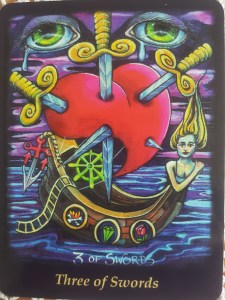
Tarot Insights: Three of Swords

Everybody Hurts Sometimes

Three of Swords - Bonefire deck

Most people don’t want to see the Three of Swords come up in a reading. It generally speaks of pain, misery and sorrow more obviously than any other card in the deck. On the other hand, there are times we need to see this card for our own good, so we can deal with and process those energies. Because, although it can come up as a potential future issue, I usually find the Three of Swords comes up because of some unresolved issue from the past.

No one goes through life untouched by this energy. Even in the happiest place on earth (allegedly) people die on occasion. What isn’t the same for everyone is how we deal with the emotions that come with a three of Swords experience. The healthiest thing to do is to feel them, let them impart whatever wisdom there is to be gained from such an experience, learn the lesson, then release them. So simple it can fit in a sentence. And yet so difficult it can take years, or even a lifetime, depending on how affected you are and your capacity for resiliency.

Deep emotional pain can be more than some people can bear, and as a result they will do what they can to bury those feelings in self-medication (drugs, alcohol, reckless behaviour, etc.). Alternatively, some people are more like Marge Simpson and can just “push the bad feelings down into your toes and crush them”. The problem in both cases is, instead of going away, those feelings lurk there and fester, dragging the person further down.

No matter how good you think you are at pushing away what you don’t want to feel, and even if you can do it most of the time, those feelings will still pop up at inopportune times in inconvenient ways. You will be having a jovial dinner with friends when suddenly your face goes dark and angry. You suddenly feel every drop of bitterness over that person who broke your heart, simply because there is asparagus on the table and asparagus was that person’s favourite vegetable. And now everyone is looking at you thinking “WTF?” and even if you could explain yourself you’ve already decided it sounds too mad to share.

So anyway, if you really want to start feeling something different you need to stop running and start listening to those feelings. They are trying to tell you something. That’s why they are there, and they will keep coming back until they believe you heard and understood their message. Then you will be able to release those feelings and the emotional baggage associated with them. That might take a little energy work—the longer you’ve held onto them the harder it can be to let go.

And if there is a lesson for you in this message from your emotions, I would recommend learning it and acting on it. Lessons not learned have a habit of recurring until they are learned—the universe seldom gives up. If you decide to opt out of the lesson, you might want to read this post again in preparation for reliving it.

The Daily Draw: Three of Pentacles

pents03.jpgI know I haven’t been around much through October. Let’s just say life was complicated, most of my time went to others, and I ended up feeling drained and run down.  There’s no point thinking the demands won’t continue, because they will, but I’m getting a better handle on retaining a bit of that energy for myself, focusing on what charges my batteries, which includes writing this blog for all of you.
And so we get to today’s card, which is the Three of Pentacles, a card about planning and and teamwork.  This might seem a bit ironic after that first paragraph about focusing more on what I want, as opposed to contributing more to the group of people that depend on me, but let’s look at that.

Being part of a team means contributing your time and energy to work towards a common goal. The assumption is that everyone on the team is also making a contribution. Of course, we all have our strengths and weaknesses, and we all bring different talents to the table, but overall there should be a balance—if I do more of this, then somebody else should be able to do more than that, resulting in a fair distribution.  And in that fair distribution some people may seem to do more than others, but everyone is working to the best of their ability.

On the other hand, there are some teams where some members are quite happy to let other’s carry their weight. The imbalance isn’t because they can’t contribute more, it’s because they don’t want to. Now, the knee jerk reaction here is that they are lazy gits and need to be kicked to the curb, and that may well be true in some cases. But there is also a possibility they may feel overshadowed by other people on the team.

When you’re younger or less experienced for example, you may be the recipient of a lot of, shall we say, constructive feedback (criticism). When this feedback becomes a constant, which surely it will be when working with more experienced people, it can become tiresome for the recipient even if the feedback is given in soothing tones with the best intentions. And when it’s given more harshly it can downright piss a person off and cause them to feel bad about themselves. “What is the point of even trying? Johnny Super-Team-Member is going to come along and do it all again better and faster just to make sure it’s perfect, and Joey Blowhard is going to go on about how experienced he is and how much he knows in great, painful detail.”

Meanwhile Johnny S.T.M. is wondering why he has to do everything around here, and Joey Blowhole is thinking “Why don’t people listen to me more when I’m always right?”  OK, Joey needs to get over himself. But Johnny needs to take a step back and remember a time when he wasn’t quite so capable, and how he became that way. He learned by doing, like we all do. No matter how much you read or are taught, you still need the practical experience to develop your skill.

Not everything has to be perfect all the time. Most jobs just need to be done well enough.  If Johnny and Joey can live with that, the new guy will have the space to do work that won’t be redone and over criticised, something they can stand by, self-evaluate and learn from. That way they feel like they’re making a real contribution. Chances are they will like that feeling and want to keep building on it. Then Johnny might start to believe that he can trust someone else to do the job and Joey…well, while we respect your knowledge and experience,  just take it down a notch Joey, alright?

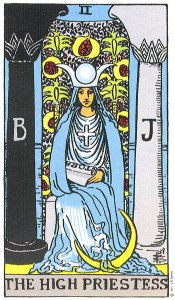
The Daily Draw: The High Priestess

Deep and Flowing

The High PriestessAt the top of the tarot deck, just past the fool, are the archetypes of male and female energy in their purest form—The Magician and the High Priestess, and they are apparent opposites. The Magician ‘s realm is the conscious mind, the power of taking action, exerting will to shape and change the elements around him. The High Priestess ‘s realm of deep unconsciousness, the power of knowing without acting, sitting back to let whatever happens unfold on its own accord.

The High Priestess is abundant in feminine symbols. She sits before a tapestry adorned with pomegranates. She wears the familiar triple moon as a crown.  She wears a white cross against white clothes, and holds a partly hidden Torah in her hand. She also sits between the pillars of Boaz and Jachin from King Solomon’s temple, all of which are nods to patriarchal religions. However overall is a blue gown, encompassing the various religious trappings—they are within her but none are her entirely.

That gown that seems to flow like water as it nears her feet, where there is a large crescent moon.  And from what we can glimpse behind the tapestry, thee is even deeper water beyond. This is the wisdom of her emotions, her intuition. We long for a better look behind the tapestry but we cannot simply part it and walk through. The High Priestess has the patience of eternity to wait for us to find our way in.

In her passive gaze is a truth we cannot always grasp, in our eagerness to shape our worlds, to fix their problems, to go, to do, to be. That is, sometimes the best course of action is no action at all. That instead of pushing out, we should focus in and see how deep we can submerge into our own bodies of water where we can see what is hidden, where we can understand what we have forgotten, where we can know and be one with all, and thereby know ourselves.